

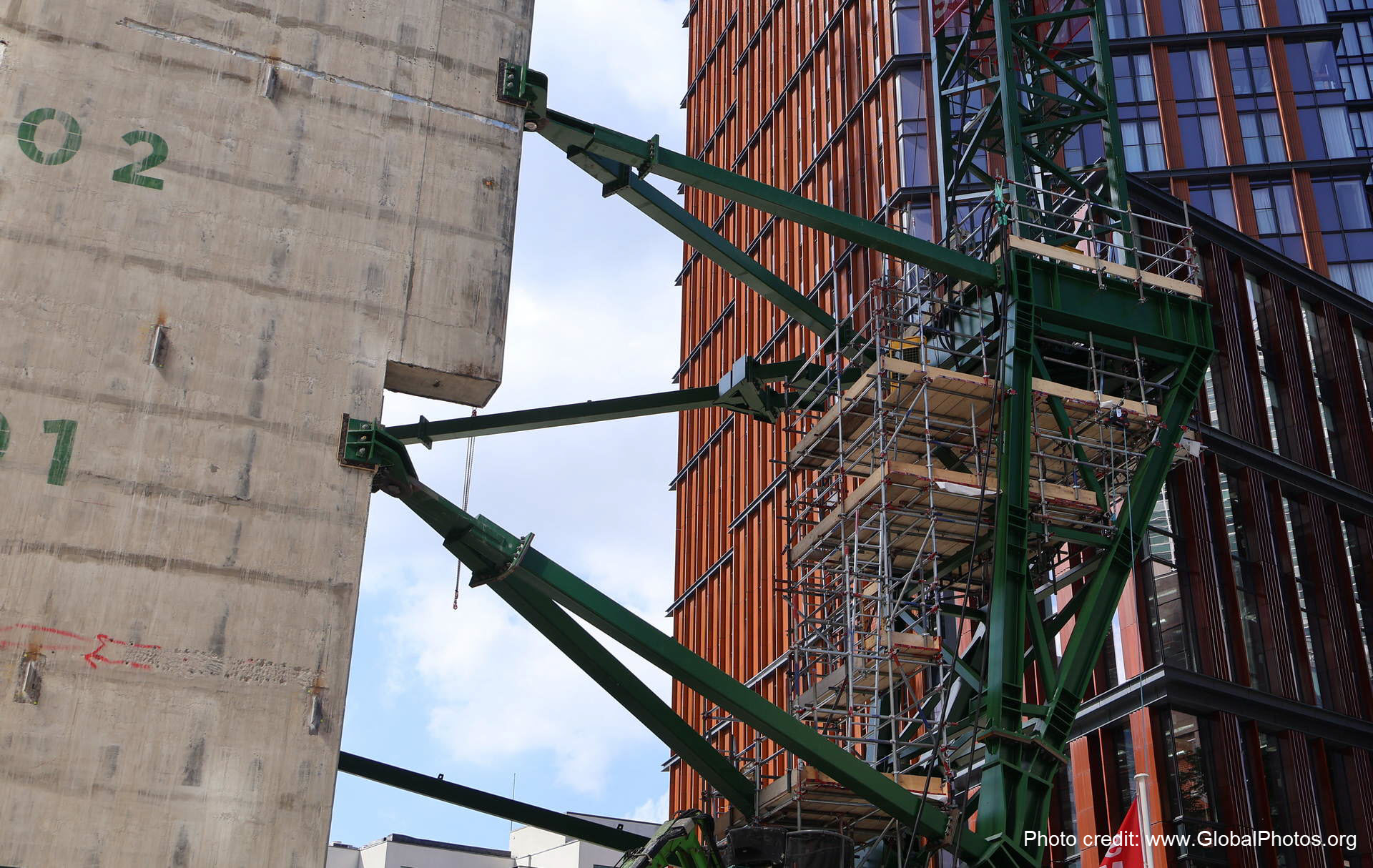
Constrained urban sites do not always provide a suitable location for a conventional tower-crane foundation. In some cases, the support structure must become part of the building itself, using steel grillages connected directly to reinforced-concrete cores.
Our latest article in The Structural Engineer magazine in November explores the engineering challenges behind these unusual structures and how IDEA StatiCa can help engineers follow the complete load path – from the crane and steel grillage, through its complex connections and cast-in plates, and into the anchors, reinforcement and concrete core.
When connections become central to the design
The article uses the floating tower crane at 2 Finsbury Avenue in London to illustrate the challenge. With emergency access and congested underground services preventing a conventional foundation, the crane was supported on a substantial steel grillage cantilevering from the building’s concrete core.
Solutions of this kind depend on much more than the resistance of the primary steel members. Their connections may be required to transfer combinations of axial force, shear, bending, torsion and load reversal through non-standard geometries and between different structural materials.
From complex steelwork into reinforced concrete
IDEA StatiCa Connection allows engineers to model the actual geometry of grillage intersections, cantilevers, bolted splices, welds, stiffeners and connections to embedded steelwork.
At the steel-to-concrete interface, the external steelwork, cast-in plate, anchors and welded reinforcement can be analysed within the same connection model. Where the surrounding concrete requires more detailed investigation, the anchorage model can continue into IDEA StatiCa Detail 3D.
This connected workflow enables engineers to examine how forces are distributed through the steel connection, plate and anchorage system before spreading into the reinforced-concrete core.
It provides a clearer route from the global structural concept to detailed verification of the critical interfaces—helping engineers develop solutions that are not only safe, but also practical to fabricate and construct.
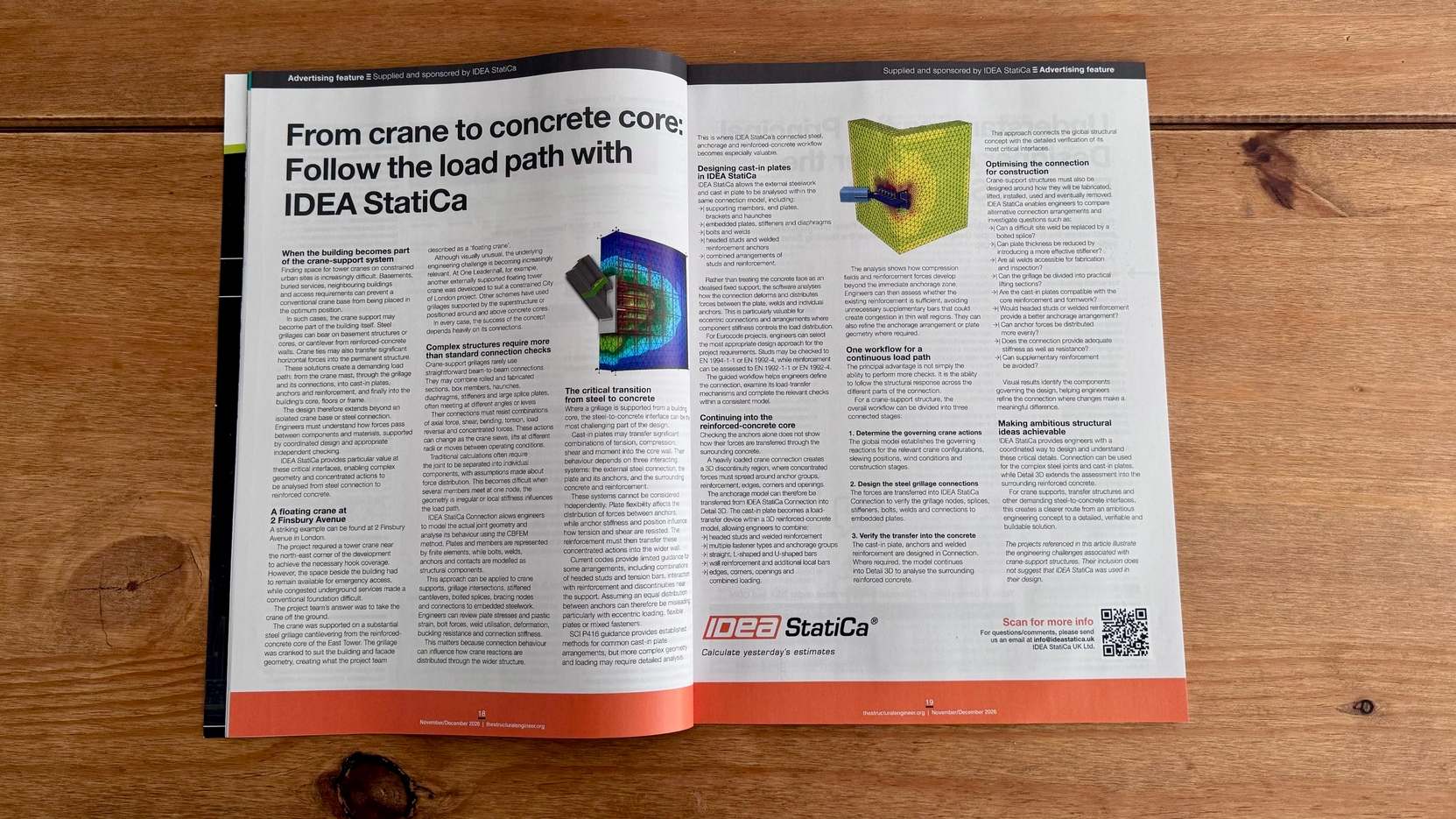
Read the full article
“From crane to concrete core: Follow the load path with IDEA StatiCa” appears on pages 18–19 of the November/December 2026 issue of The Structural Engineer.